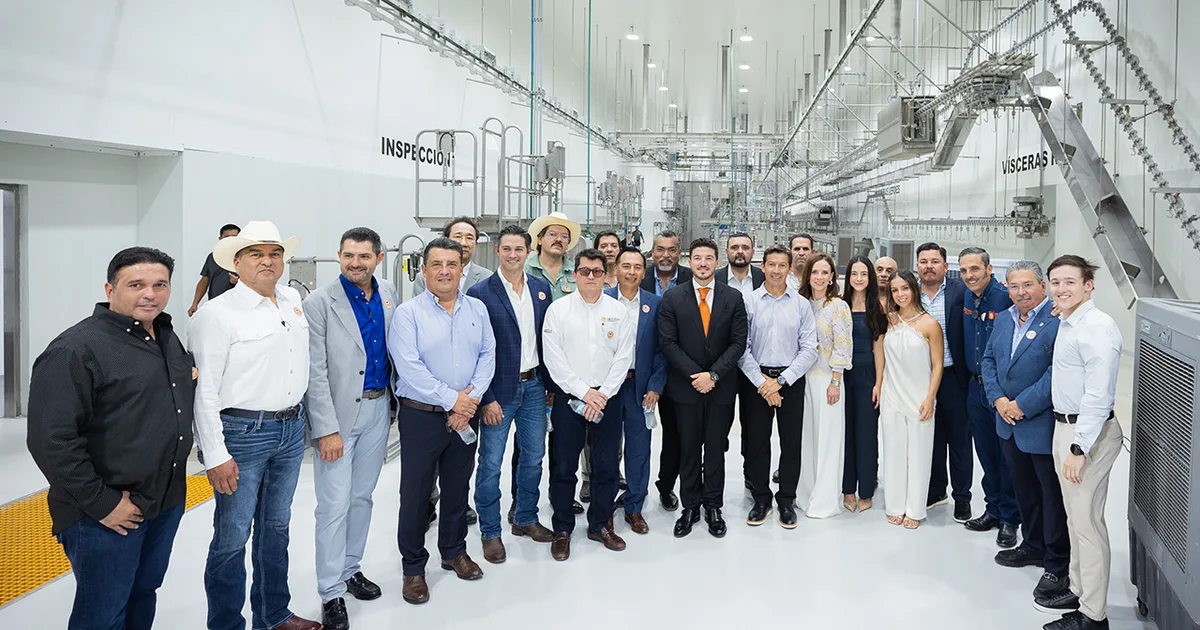
Interior de la planta de procesamiento de ganado de Grupo San Gabriel en General Escobedo, inaugurada el 3 de septiembre de 2026. Fotografía del boletín oficial. Ilustra una de las tres instalaciones que reúne esta nota. Imagen recortada a proporción de portada. 사진: Gobierno del Estado de Nuevo León.
주요 정보
- ALMER, Monterrey
- Over MXN$500M, company-declared
- San Gabriel, General Escobedo
- About MXN$500M per the state; over MXN$450M per the municipality
- Danfoss, Apodaca
- No public figure
- Reported jobs
- San Gabriel, 150 direct and 450 indirect. ALMER and Danfoss released no figure
- Window
- August 28 to September 3, 2026
- Status
- All three operating
Between August 28 and September 3, 2026, three industrial facilities opened in Nuevo León, the northern Mexican state whose capital is Monterrey. Taken one at a time, none of them is a big story. One released no employment figure. One has two different investment numbers, both from government and neither from the company. The third has no figure at all, and never will, because the company is privately held and that number does not exist in public.
Taken together they are something else. All three solve the same physical problem, which is pulling heat out of something and keeping it cold, and between them you can see both sides of the cold economy in this state: who buys cooling, and who builds it.
In August we published which investments grew beyond what was announced. This is the other half of that exercise. Not what grew, but what opened.
A note on geography for readers outside Mexico. The Monterrey metropolitan area is made up of separate municipalities, each with its own government and its own industrial profile. The three facilities below sit in three different ones, Monterrey, General Escobedo and Apodaca, all inside that same metro area.
A cold store that fit inside the city
ALMER, the trade name of the Mexican company Almacenadora Mercader, opened its temperature-controlled distribution center on August 28 at Avenida Churubusco 929, colonia Venustiano Carranza, an address the company itself publishes and that falls inside the municipality of Monterrey. ALMER is part of Grupo PEO and declared an investment of more than MXN$500 million. The facility is already open and running, and trade outlet T21, whose reporter covered the ribbon cutting, describes that money as already spent.
The specifications are those of a serious building: a 15,000 square meter site, roughly 9,000 square meters built, of which 6,500 are temperature controlled. Four freezer chambers at minus 20 degrees Celsius holding close to 15,000 storage positions, blast freezing chambers at minus 38 degrees, 12 dock doors and a maneuvering yard of more than 4,000 square meters.
The number that explains the address is none of those. It is the refrigerant. The plant runs on carbon dioxide, R744, instead of ammonia, and the company said that choice is precisely what allowed it to put a freezer warehouse inside Monterrey's urban area. Ammonia is the workhorse refrigerant of heavy industrial freezing and it is toxic, which is why buildings that use it tend to end up far from dense population. This one did not have to.
It is worth being precise about what this opening is and is not. It is not ALMER's arrival in Nuevo León, because the company already operated here, and according to trade outlet Mexico Industry this is its seventh facility in the metropolitan area. It is its first cold store in the state, and its second in the country after Guadalajara.
Two things this article does not carry, because the sources do not carry them. ALMER released no employment figure, and its investment number is a company declaration with no breakdown and no registry behind it, always written as a floor, "more than 500 million pesos," never as a closed figure. We also found no state government bulletin on this opening, although the official portal's search does not respond, so that absence is not proven.
One more detail, which comes back at the end of this piece. According to Mexico Industry, the only outlet that published the list, the cold store was built by INFRISA of Spain, its compressors are Bock of Germany, and its controls and valves are Danfoss.
In Escobedo, the cold chain starts at the pen
Grupo San Gabriel opened its cattle processing plant in General Escobedo on September 3. Governor Samuel García cut the ribbon and put the private investment of this first stage at "close to 500 million pesos." The acting head of the Escobedo municipal government, José Antonio Quiroga Chapa, put it above 450 million. The company has published no figure of its own. Both versions appear here with the name of whoever said each one, because that is the state of the number today.
The plant starts with capacity for 600 head of cattle per day, roughly 150,000 a year, and the company projects 250,000 a year within two years. Process equipment was imported from Brazil and the refrigeration system from Denmark. The pens follow the handling principles of Dr. Temple Grandin, the American animal scientist whose layouts became the reference for animal welfare in the meat industry. Grupo San Gabriel reported 150 direct jobs and 450 indirect ones.
There is one distinction here that deserves slow reading, because it is where half of the errors about new plants come from. What the plant has today, in the words of its own president, Gabriel Guardado, on opening day, is the infrastructure to obtain the certifications that would let it send Mexican beef to the United States, Canada, Japan and Korea. That is installed capacity with the paperwork still ahead, which is why this article does not write that the plant already exports. The director of Federal Inspection Type establishments, known in Mexico as TIF, at the federal food safety agency SENASICA attended the ceremony, which is consistent with a process underway and is not the same thing as a certification granted.
The state bulletin also mentions that a second stage is under consideration. It carries no figure and no date, so it is not added to the 500 million pesos of the first one. Phases are never summed here.
The third one does not buy cold, it builds it
On that same September 3, Danfoss announced in its global newsroom that it had launched an assembly line for oil-free check valves, known as OFC valves, at its plant in Apodaca. They are the component that works alongside the company's own Turbocor compressors, the ones used to cool data centers, building air conditioning systems and heat pumps.
There is no investment figure here, and that is not a reporting gap. Danfoss A/S is a privately held, family-controlled Danish company that does not list in the United States, so there is no investor report and no securities filing to cross-check against. The number does not exist in public, which is why this article does not print one.
What the company does state is scope. The line will eventually build 12 models, in 3 1/8 and 4 1/8 inch diameters, in steel or solder flange versions, with or without ball valves, in regular or compact sizes. That is the end state of the ramp, not today's catalog. The stated reason is demand for oil-free solutions, "particularly in the data center industry," and shorter lead times for original equipment manufacturers across North America.
"The launch of OFC valve production in Monterrey is a strategic investment in North America," said Vikas Anand, Vice President of Danfoss Climate Solutions in North America.
This is not a new investment on the table, and it is worth saying plainly so that nobody counts it twice. It is the next product inside the plant Danfoss expanded in November 2025. The company frames it that way itself: since the expanded factory opened, it says, it has been filling the doubled capacity with high-demand products including scroll compressors, BOCK compressors, sensors and microchannel heat exchangers. The OFC valves are the most recent in that sequence. The US$100 million of that expansion already has its own article and is not counted again here.
An address footnote, for anyone who opens the source. The Danfoss release places the factory in "Monterrey, Mexico." The company's own plant directory places it in Apodaca, Nuevo León, and so do Milenio and Mexico Industry, both of which visited the complex. It is the usual commercial shorthand. The dateline says Monterrey, the plant is in Apodaca.
Where the three touch
Go back to ALMER's supplier list, because that is the point of this piece.
Mexico Industry, the outlet that published it, reports that the cold store which opened in Monterrey was built by a Spanish firm, that its compressors are Bock and that its controls and valves are Danfoss. Both equipment brands on that list, Bock and Danfoss, have production in Apodaca: the Danfoss release itself names BOCK compressors among the lines it started there after expanding the plant, and the line it opened in September is a valve line.
No source says ALMER's equipment came out of Apodaca, and this article is not going to claim it did. What is documented is something else, and for a supplier it is more useful: the purchase list of a cold store opening in Monterrey names two equipment brands that are manufactured in Apodaca, inside the same metropolitan area. That overlap is the working definition of an industrial ecosystem, and it is what a thermal management company is actually looking for when it decides where to build.
As for San Gabriel, we know its refrigeration was imported from Denmark. Neither the bulletin nor the company says from which manufacturer, so that gap stays a gap.
What these three openings do not prove
Three ribbons in seven days are not a trend, and this article will not say they are. The calendar coincidence is a coincidence.
They are not the same market either. ALMER and San Gabriel buy cooling in order to move food. Danfoss builds it, and the stated destination of its new line is data centers, not the food chain. Those are two different demand curves sharing the same physics and a good part of the same supply base.
What the record does support is more modest and more useful. Nuevo León holds both the users of cold and the makers of it, and that did not start in late August. Invest Nuevo León's own company census already counted ten climate equipment and component companies in the metropolitan area before any of this, and August's verification exercise found Güntner going from five to six plants in the area and Yinlun running three operations in the state that build coolers and refrigeration modules. The three openings in this article sit on top of that base rather than creating it.
If your company is in this chain
- Browse the directory of industrial parks in Nuevo León, organized by municipality.
- Review options for industrial buildings, land and build-to-suit.
- Explore the state's strategic clusters and how to join their supply chains.
- If electricity is your critical variable, and in refrigeration it almost always is, start with the energy overview.
If you hold a figure this article is missing, particularly ALMER's headcount or the TIF establishment number for the San Gabriel plant, write to contacto@investnuevoleon.com. We correct, and we credit.
Sources: ALMER opening post, August 28, 2026 · Address published by ALMER on LinkedIn · Government of Nuevo León, bulletin on the opening of the Grupo San Gabriel plant, September 3, 2026 · Danfoss corporate release on the OFC valve line, September 3, 2026 · Danfoss plant directory, which places the factory in Apodaca · T21, on-site account of the ALMER opening ceremony, August 28, 2026 · Mexico Industry on ALMER, August 31, 2026 · BM Editores on Grupo San Gabriel, September 9, 2026 · Mujer Informa, municipal investment figure for San Gabriel, September 4, 2026 · Mexico Industry, plant tour of Danfoss in Apodaca, September 17, 2026 · Milenio on Danfoss in Apodaca, September 18, 2026. Context figures on climate equipment companies, Güntner and Yinlun come from our own articles and from the Invest Nuevo León company census, linked above.